Single Tooth Implant
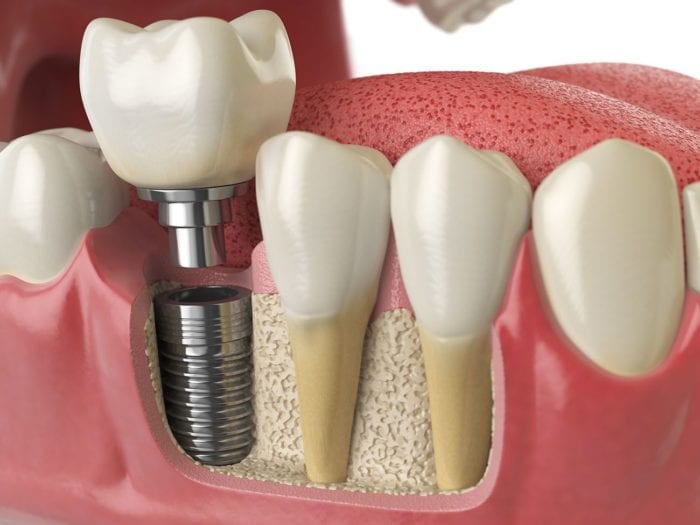
A dental implant is a small titanium post (screw) that is surgically placed within your jawbone beneath your gum line. This post will fuse with your jawbone, creating a stable foundation for your tooth restoration.
When should single-tooth implants be used?
Dental implants are a permanent way to restore a missing tooth. Our dentist will first surgically insert the implant into your jawbone. The implant functions as the new "root" once it has fused to the bone. A crown, also known as a cap, is affixed to the implant to replace the missing tooth.
Your jawbone must be robust enough to sustain the implant to be considered a candidate for dental implants. The surrounding tissue and teeth must be in good condition. If there is insufficient bone to support it, bone grafting might be used to provide more.
The dentist must do an exam in addition to a comprehensive assessment of your medical history. For instance, diabetes, liver illness, or a severe bleeding disorder could rule out a candidate for dental implants.
If you want more information regarding implants, consult our dental experts.
Call Us Now or For More Information Click Here
How does a single-tooth implant work?
A single-tooth implant consists of several parts:
- The implant, made of titanium and shaped like a screw or post, is placed into the jawbone.
- The abutment, made of titanium, gold, or porcelain, is attached to the implant. This part connects the implant to the crown.
- The crown is made of porcelain fused with metal (PFM), all-metal, or all-porcelain. Your crown will be made to match your other teeth and will be attached to the abutment.
Multiple Implants
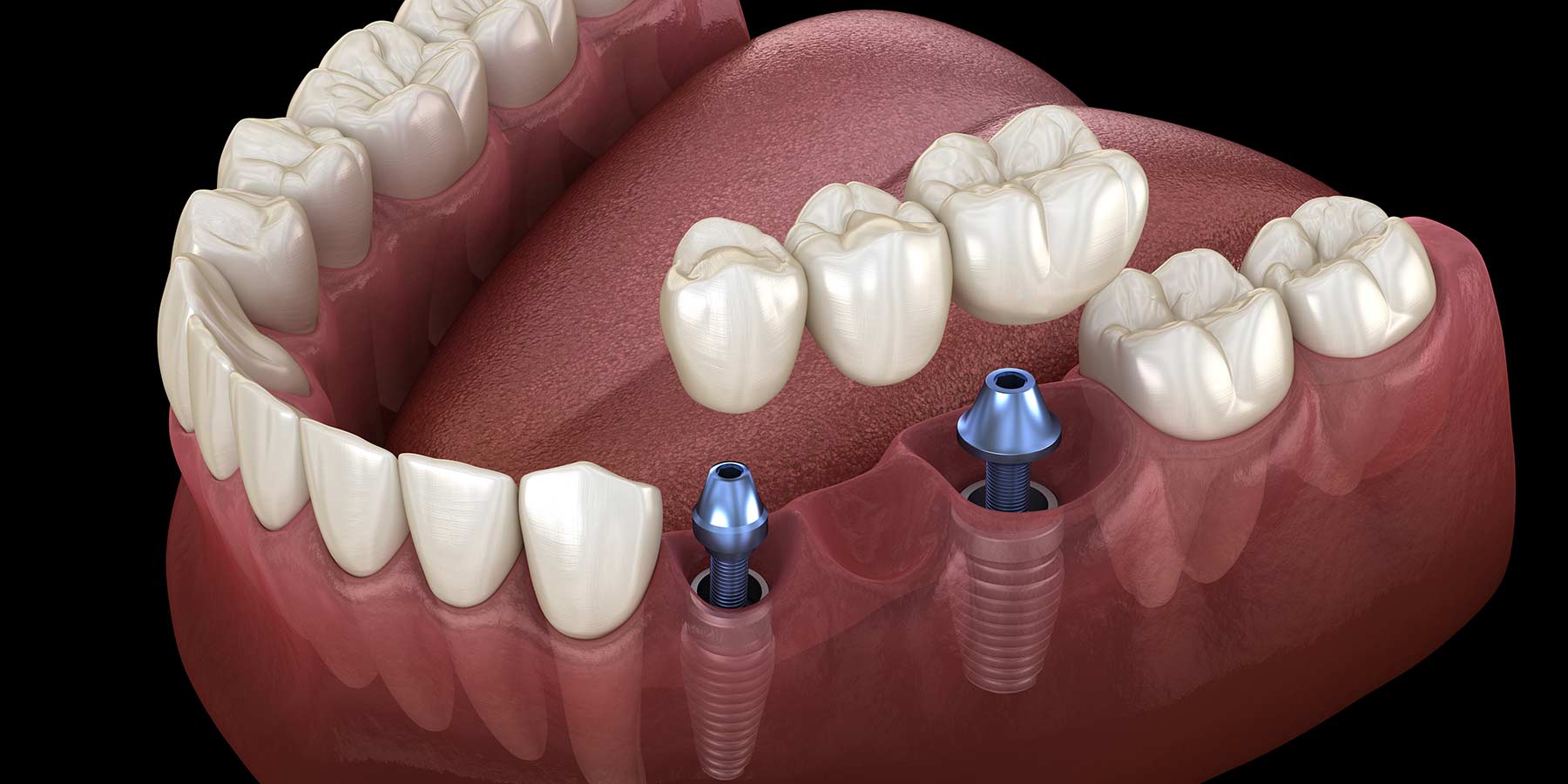
Multiple tooth implants
Just as a single missing tooth can be replaced with a dental implant, the same goes for several missing teeth. Implant-supported teeth are fixed in the mouth permanently, but removable appliances such as dentures are not. Unlike removable devices such as dentures, dental implants do not slip, click, or fall out when speaking, eating, or engaging in activities. Dental implants also help to protect the jawbone and prevent bone degradation because they are put directly into the bone.
Do not dismiss the possibility of missing rear teeth. Multiple teeth lost due to decay, gum disease, or neglect will result in bone loss surrounding your remaining teeth, forcing them to become loose, rotated, and movable. Don't feel smug because your lost teeth are in the back of your mouth! It is in your best interest to get implants to replace your missing teeth as soon as possible to avoid cascading damage to other teeth.
What is the procedure for Multiple Tooth Implant Treatment?
This process typically entails four visits to the dentist. You should be able to return to work the day after the implant is placed.
The treatment mentioned here is one of the various possibilities.
- Before the procedure: The dentist makes a first examination and takes one or more x-rays of the area to prepare for the procedure.
- Installing the implant: Titanium tooth implant bases are placed into the jawbone to replace the function of the roots. We allow a period for the jawbone to heal over the bases before fitting for a crown.
- Attaching the new crown: Once the area has healed, the abutments are attached to the dental implants. These components are then used to hold custom-made ceramic crowns that the dental laboratory will mold and match to your existing teeth.
- The result: Finally, custom fabricated crowns are placed over the tooth implant abutments and will function like a natural tooth.
If you want more information regarding implants, consult our dental experts.
Call Us Now or For More Information Click Here
Implant Supported Denture
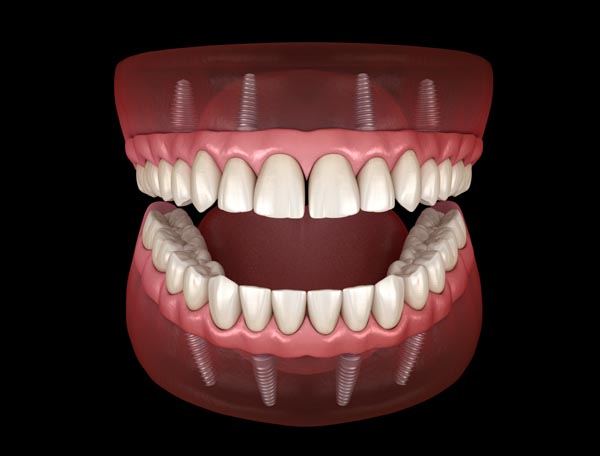
Patients benefit greatly from implant-supported dentures. Implant-supported dentures are indeed a combination of traditional adhesive-supported dentures and more expensive advanced full-arch dental implants.
For people who want to improve their chewing and smiling ability at low cost, implant-supported dentures are excellent choices. The dental implant provides the support necessary for the dental fixture to be shaped into a horseshoe, reducing bulk and expanding the palate, giving the tongue more space and making the taste more accurate. Dentures supported by implants are more stable and do not require adhesive.
Individuals can enhance their nutrition by eating fruits and vegetables, steaks, corn on the cob, and other foods that would be prohibited with regular dentures. Furthermore, implant-supported dentures dramatically boost patient’s confidence in their ability to smile and talk.
This type of denture is detachable as you can snap it on and off as often as you like. It implies that cleaning and maintaining the denture is the same as cleaning and keeping a standard denture.
Benefits of Implant-Supported Dentures:
- They are an affordable option for improvement in the ability to chew and smile.
- Implant-supported dentures are sturdy and don’t need adhesive.
- They function more like natural teeth.
- The denture is removable, making it easy to clean.
- This option preserves gum tissue and bone.
Contact us to schedule a consultation if you believe you could be a candidate for implant-supported dentures.
Call Us Now or For More Information Click Here
What is the Process for Placing Implant-Supported Dentures?
Essentially, the existing denture becomes the interim denture after the implant surgery. Four months later, the patient gets a new denture that snaps onto their implants. The process is simple and includes a series of appointments with your dentist.
Your first meeting will be a consultation to go over the process and care plan that will be customised for you. You will review the entire operation with your dentist and other crucial elements to consider when considering whether implant-supported dentures are best for you.
Your dentist will be able to show you models and answer any questions concerning implant-supported dentures.
All-On-Four
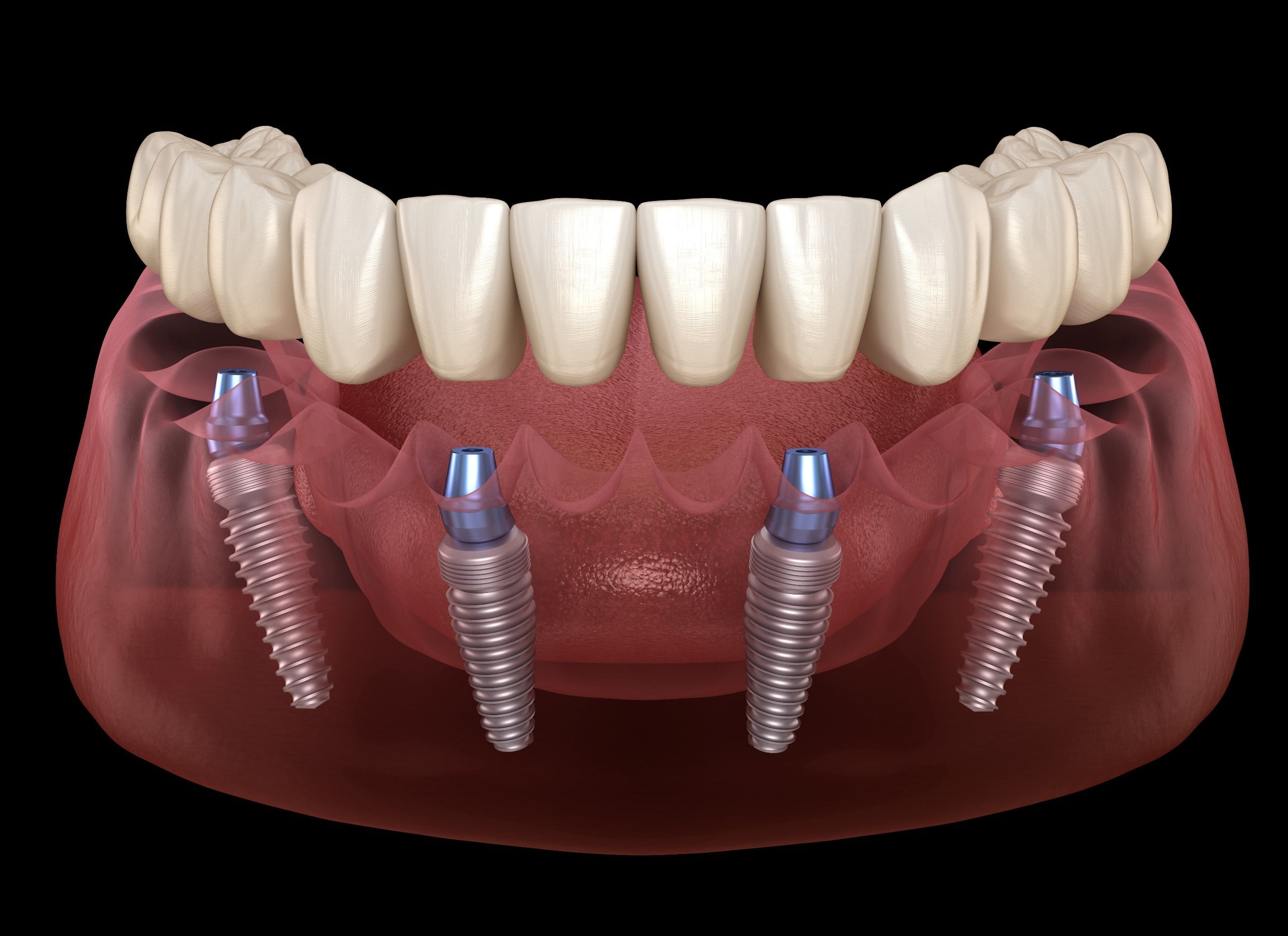
All-on-4 is a novel way to replace several lost teeth and reconstruct a patient's mouth to restore full function.
Teeth loss is an unfortunate circumstance that can occur due to various factors. Sometimes it's due to an unintentional impact, advanced stages of tooth decay, or other oral health issues. Regardless of the underlying reason for missing teeth, it is a condition that must be addressed with caution to restore the patient's mouth to full function. One of the most fascinating and modern approaches to reaching this goal is the All-on-4 procedure.
What does the term "All-On-4" mean?
All-on-4 refers to all teeth being supported "on four" dental implants. It is a prosthodontics procedure for total rehabilitation of toothless patients or patients with badly broken down teeth, decayed teeth, or compromised teeth due to gum disease.
What is the procedure for All-on-4?
We recognise that many individuals are scared of almost any dental surgery. Getting dental implants for the first time can be nerve-racking. Most dental implant anxiety and concerns stem from a lack of awareness about the procedure. We do not want our patients to be concerned about uncertainty while they prepare for this treatment, so let us take it one step at a time.
- First Step: Our dentist wants you to be comfortable with a procedure like this, so local or general anesthesia is given to make the process much smoother.
- Second Step: Our dentist will prep your mouth for the implantation of titanium screws, which may include extracting any remaining teeth that are severely damaged. Then our dentist will also treat infected gum or diseased tissue from your jaw and gums.
- Third Step: The Implantation Phase begins with inserting the screws into the jawbone at the necessary positions, typically two at the front of the mouth and two at the back of the mouth, to evenly distribute the force of the denture when chewing.
- Final Step: Our dentist will thoroughly clean the surgery site, stitch the incisions, and bring you to the recovery area to relax and recuperate from the anesthesia. And that is all! You are almost there!
What is the Process for Placing Implant-Supported Dentures?
Essentially, the existing denture becomes the interim denture after the implant surgery. Four months later, the patient gets a new denture that snaps onto their implants. The process is simple and includes a series of appointments with your dentist.
Your first meeting will be a consultation to go over the process and care plan that will be customised for you. You will review the entire operation with your dentist and other crucial elements to consider when considering whether implant-supported dentures are best for you.
Your dentist will be able to show you models and answer any questions concerning implant-supported dentures.
You should also rest as often as possible and eat soft foods over the next 3-4 days to avoid irritating the surgical site.
Don’t put off your new smile another day. Make the call and schedule yourself for a consultation with Manoj Dental Care and get your smile back with All-On-Four!
Call Us Now or For More Information Click Here
Zygomatic Implants
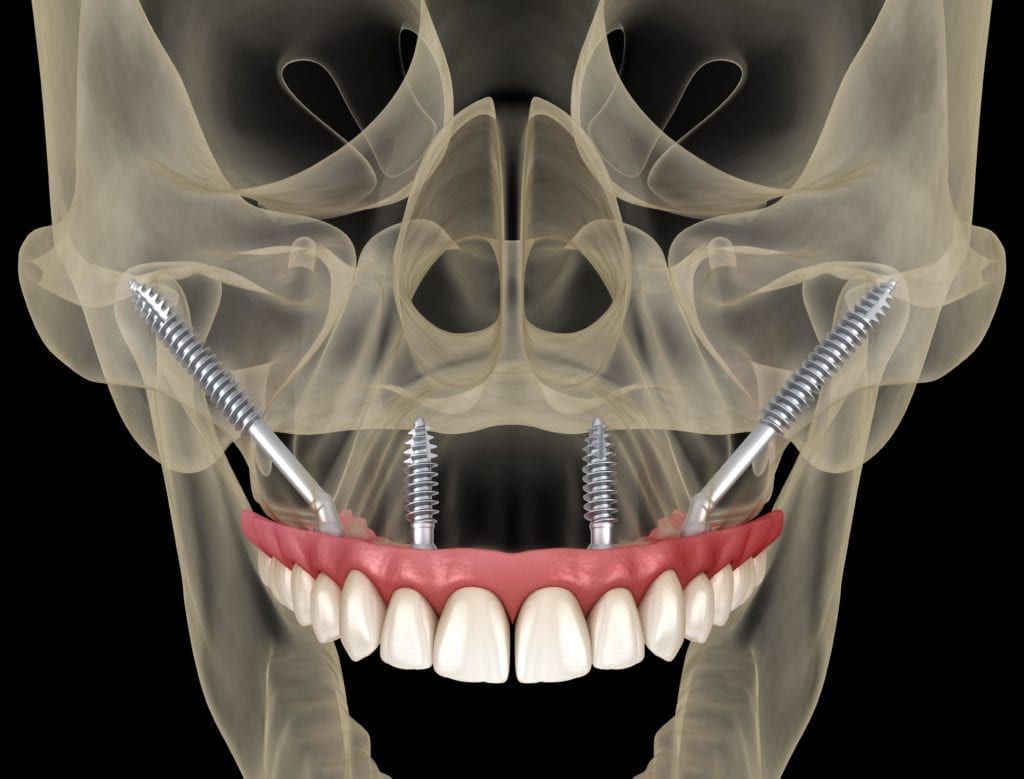
Patients who want dental implants but have extensive bone loss in the upper jaw can benefit from zygomatic (Zygoma) implants. This procedure eliminates the need for bone grafting (bone augmentation). Unlike traditional "root-form" dental implants, which are placed in the jaws to replace teeth, these implants are inserted into the zygomatic bone (cheekbone) to support upper jaw (maxillary) teeth, bridges, and dentures.
What Are Zygomatic Implants?
Zygoma implants are placed in to the zygomatic bone (cheek bone), which would be denser than the upper jaw. This strong foundation for implant stability distributes stress across a large region, allowing for the successful rapid installation of dental bridges during surgery (no need to use a denture or go without teeth for any period). These implants have been used safely and successfully since the late 1980s.
Zygomatic implants commonly called "Zygoma," traverse into the deficient area of your upper jaw to attach to the bottom of the cheekbones through your sinuses and are an alternative to bone grafting procedures in the upper jaw. These implants are put into the back area of your jaw from within your mouth and can be coupled with one or more standard (root form) implants in the front part of your jaw.
Depending on the requirement of the patients, either two (one on each side) or four (two on each side) implants are put into place to support full or partial dental bridges.
When conducted by a professional surgeon with knowledge of the method, the treatment is safe and predictable. The surgery is a day-stay surgery under anesthesia, and a complete set of teeth can be attached to the implants on the same day of surgery.
What are some of the advantages of zygomatic implants?
Zygomatic implants restore patients' self-confidence by improving the appearance and aesthetics of their smiles; they also ensure a return to enjoying social outings and interactions as a result of the better oral function (speech, eating, and swallowing) associated with fixed dental bridges.
Apart from improved speech, eating, and swallowing, appearance, and low maintenance of teeth, there are other benefits of zygomatic implants. These include:
- Bone grafting is rarely needed.
- This treatment is suitable for patients with severe bone loss.
- Dental bridges are attached to the implants on the same day as surgery.
- Zygomatic implants have a role in providing dental support to cleft lip and palate patients who are unable to tolerate more conventional treatments.
- One zygomatic implant can support 3-4 teeth; one regular dental implant supports 1-2 teeth.
- Four zygomatic implants can support a full upper dental bridge.
- Zygomatic implants can be used to salvage other failed or failing dental implant treatments (All on 4; mini-implants; failed bone grafts; severe periodontal breakdown of the existing teeth).
Do you want to learn more about the benefits and drawbacks of zygomatic implant surgery? Contact the experts at Manoj Dental Care today.
Call Us Now or For More Information Click Here